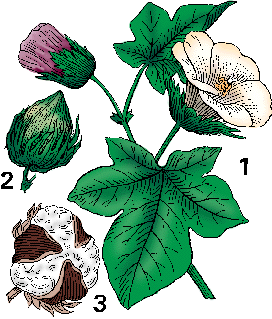
: a soft usually white fibrous substance composed of the hairs surrounding the seeds of various erect freely branching tropical plants (genus Gossypium) of the mallow family
b
: a plant producing cotton
especially: one grown for its cotton
c
: a crop of cotton
2
a
: fabric made of cotton
b
: yarn spun from cotton
3
: a downy cottony substance produced by various plants (such as the cottonwood)
… cottoned on to the fact that our children work furiously …—H. M. McLuhan
Did you know?
The noun cotton first appears in English in the late Middle Ages. It comes, via Anglo-French and Old Italian, from the Arabic word for cotton, quṭun or quṭn. In the 15th century, cotton acquired a verb use meaning "to form a nap on (cloth)." Though this verb sense is now obsolete, our modern-day use might have spun from it. In 1822, English philologist Robert Nares reported that cotton had been used to mean "to succeed" and speculated that this use came from "the finishing of cloth, which when it cottons, or rises to a regular nap, is nearly or quite complete." The meaning of cotton shifted from "to get on well" to "to get on well together," and eventually to the sense we know today, "to take a liking to." The "understand" sense appeared later, in the early 20th century.
Noun
They are in the field picking cotton.
She doesn't wear cotton in the winter. Verb
failed to cotton on to the fact that her senatorial campaign was going nowhere
Recent Examples on the Web
Examples are automatically compiled from online sources to
show current usage.Read More
Opinions expressed in the examples do not represent those of Merriam-Webster or its editors.
Send us feedback.
Noun
Glover said the individuals buried in the cemetery were people who picked cotton, worked and built Dallas from the ground up.—Dallas Morning News, 31 Jan. 2026 This Vera Bradley tote is covered in a playful candy print and made from soft, lightweight cotton.—Jeaneen Russell, PEOPLE, 31 Jan. 2026
Verb
The concept never quite cottoned with consumers though and the stores were more of a curiosity than a mass market phenomenon.—Alexei Oreskovic, Fortune, 28 Jan. 2026 When washed, textiles using HV100 perform closer to cotton with highs and lows.—Carved, Sourcing Journal, 22 Oct. 2025 See All Example Sentences for cotton
Word History
Etymology
Noun
Middle English coton, from Anglo-French cotun, from Old Italian cotone, from Arabic quṭun, quṭn
: a soft usually white fibrous substance composed of the hairs surrounding the seeds of various erect freely branching tropical plants (genus Gossypium) of the mallow family and used extensively in making threads, yarns, and fabrics (as in surgical dressings)